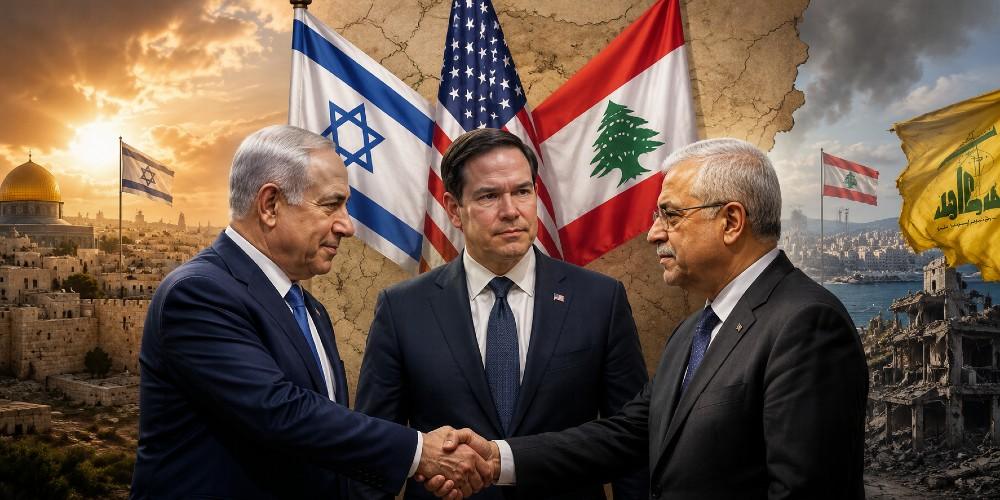
The United States has once again stepped into the breach of Middle Eastern conflict, convening Israeli and Lebanese representatives for a high-level trilateral meeting that yielded a conditional ceasefire agreement. Released on Wednesday, the joint statement signals incremental progress toward stability along the Israel-Lebanon border, but it also underscores the persistent reality that true peace remains hostage to the disarmament of Hezbollah, Iran’s most potent proxy in the region.
This fourth round of talks, held June 2-3 in Washington, builds on prior efforts to de-escalate hostilities that intensified alongside broader regional tensions. Israel and Lebanon have agreed to implement a ceasefire, but only upon the complete cessation of Hezbollah attacks and the full withdrawal of its operatives south of the Litani River.
Lebanese Armed Forces are to assume exclusive control in designated pilot zones, sidelining non-state actors. Both nations reaffirmed their commitment to sovereign decision-making, rejecting external interference in their bilateral future.
The statement explicitly condemns Iran’s destabilizing activities, from proxy support to direct aggression. This acknowledgment aligns with long-standing conservative critiques of policies that emboldened Tehran, allowing groups like Hezbollah to amass arsenals threatening not just Israel but Lebanon’s own stability. For years, Hezbollah has operated as a state within a state, undermining Beirut’s authority while dragging Lebanon into cycles of violence that serve Iranian ambitions rather than Lebanese interests.
Under U.S. facilitation, the parties committed to direct negotiations aimed at resolving outstanding issues and forging a comprehensive security framework. This includes bolstering the Lebanese military with American support to assert sovereignty across its territory. Israel, for its part, insists that genuine security requires Hezbollah’s full disarmament—a non-negotiable position rooted in the hard lessons of past conflicts and broken agreements.
The Limits of Diplomacy Without Strength
While diplomatic breakthroughs deserve measured optimism, history cautions against premature celebration. Previous ceasefires in the region have often served as respites for terrorist groups to rearm, regroup, and strike again. Hezbollah’s exclusion from these talks speaks volumes; the Iran-backed militia has historically rejected any framework that curtails its power. Lebanon’s government, though signaling willingness to proceed, faces the monumental task of enforcing terms against an entrenched armed faction that answers to Tehran, not Beirut.
The agreement’s emphasis on pilot zones where the Lebanese Armed Forces take charge represents a pragmatic test. Success here could demonstrate whether Lebanon’s institutions can reclaim territory long ceded to militants. Failure would confirm what many have long argued: without decisive action to dismantle Hezbollah’s infrastructure, any truce remains a temporary illusion. The U.S. pledge to enhance Lebanese military capacity is welcome, yet it must pair with unyielding pressure on Iran and its proxies.
Israel’s position remains clear. Its security cannot hinge on international assurances alone but requires verifiable elimination of threats at its border. This stance reflects a fundamental truth often overlooked in diplomatic circles: nations have a moral duty to defend their people against existential dangers, a principle deeply embedded in the Christian understanding of just governance and self-preservation.
Rejecting Hostage-Taking in International Affairs
Both Israel and Lebanon rightly affirmed that their relationship must be determined by sovereign governments, not hijacked by non-state actors or foreign powers. This rejection of hostage politics directly challenges the model Iran has perfected—using Hezbollah as a spearhead to project power while maintaining deniability. The joint statement’s condemnation of such tactics marks a rhetorical step toward accountability, one that should guide future U.S. policy in countering Tehran’s regional network.
Secretary of State Marco Rubio’s prior characterization of Hezbollah as an enemy not only of Israel and America but of Lebanon itself cuts through the fog of equivocation. It recognizes that the Lebanese people suffer most acutely from this parasitic arrangement, their prosperity and peace sacrificed on the altar of radical ideology.
As negotiations reconvene the week of June 22, the stakes extend beyond bilateral security. This process tests whether American leadership, grounded in strength and moral clarity, can foster genuine progress where past administrations faltered through accommodation or withdrawal.
“And I will bless them that bless thee, and curse him that curseth thee: and in thee shall all families of the earth be blessed.” (Genesis 12:3)
Scripture reminds us that alliances and efforts aligned with defending the innocent and upholding justice carry profound weight. In this case, supporting Israel’s right to secure borders while encouraging Lebanese sovereignty free from terrorist domination reflects a pursuit of ordered liberty over chaos.
Whether this ceasefire holds and evolves into lasting peace depends on enforcement and resolve. Half-measures against Hezbollah will invite renewed aggression. The coming weeks will reveal if this trilateral framework represents real momentum or merely another chapter in the long struggle against those who prioritize conquest over coexistence.
- Hand-curated links from conservative and Christian sites — NO legacy media garbage links. Patriots get their news every day at JDRucker.com