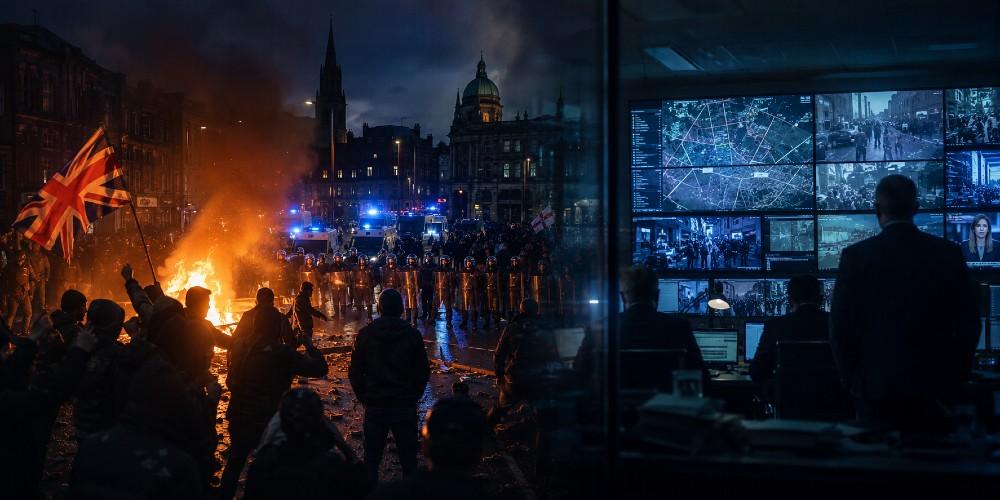
In the wake of violent unrest in Belfast sparked by yet another brutal attack involving an asylum seeker, details have emerged of a secretive government operation working overtime to shape what the British public is allowed to think and say about the failures of mass migration. This isn’t organic crisis management—it’s engineered narrative control, straight out of a Cold War playbook, now deployed against ordinary citizens frustrated by unchecked violence and cultural erosion.
The Research, Information and Communications Unit (RICU), a 22-person team tucked away in the Home Office, traces its roots to 2007 under the guidance of the late Charles Farr, a former MI6 officer. Established as part of the Prevent counter-terrorism strategy, RICU was ostensibly meant to counter Islamist propaganda.
But its mission has morphed into something far more insidious: managing “racial tensions” by steering media coverage, influencing police statements, and even scripting victim family responses to downplay the role of immigration in Britain’s growing disorder.
While streets in Belfast burned last week following the savage stabbing of Stephen Ogilvie—allegedly at the hands of 30-year-old Sudanese asylum seeker Hadi Alodid, who left his victim blinded in one eye—RICU was reportedly advising local police on how to “control the narrative.”
Sources describe efforts to portray protesters as “unsympathetic thugs” rather than concerned residents, while working behind the scenes with intelligence units to monitor online calls to action. Similar interventions followed the murder of 18-year-old Henry Nowak in Southampton by Vickrum Digwa, where false claims of racial abuse initially muddied the response.
This pattern reveals a deeper rot. Britain’s elite response to crime and migration isn’t about addressing root causes—like porous borders, failed integration, or the import of incompatible values—but about suppressing dissent. RICU’s tactics echo historical propaganda units, such as the Attlee-era Information Research Department aimed at countering communism.
Today, the “dark arts” include planting stories, deploying undercover operatives to distribute flowers and hashtags like #TurnToLove after terror attacks, and even funding boy bands to sing anti-radicalization tunes in Muslim schools. One operation after the 2017 London Bridge attack involved a PR firm pushing tales of a heroic imam to soothe tensions.
The Cost of Suppressed Truth
Such manipulation doesn’t heal divisions; it festers them. When families of victims receive “help” crafting statements that avoid inflaming “tensions,” it robs them of raw grief and honest testimony. When police are coached to frame legitimate outrage as thuggery, trust evaporates.
Critics, including Sir William Shawcross in his Prevent review, have noted RICU’s apparent bias: a lower threshold for scrutinizing the “far-Right” than for Islamist extremism. Viewing habits like classic BBC shows or Shakespeare were flagged as potential gateways to white nationalism—a laughable overreach that exposes ideological capture.
Recent incidents underscore the urgency. In Belfast, Alodid’s attack triggered riots amid broader fury over asylum policies and crime. In Southampton, Digwa’s false racism claims against the dying Nowak highlighted how “two-tier” sensitivities can endanger justice.
These aren’t isolated tragedies but symptoms of a system prioritizing optics over safety and cultural cohesion. Unfettered migration from regions with vastly different norms has strained communities to the breaking point, yet authorities double down on narrative management instead of honest debate or policy reversal.
The unit’s expansion into “non-crime hate incidents”—now curtailed after backlash—further illustrates the threat to free speech. Monitoring everyday discourse under the guise of harmony risks turning Britain into a surveillance state where questioning multiculturalism is the real extremism. As public patience frays, this approach only fuels cynicism toward institutions that appear more interested in controlling perception than confronting uncomfortable realities.
Britain stands at a crossroads. The biblical warning in Isaiah 5:20 rings especially true here: “Woe unto them that call evil good, and good evil; that put darkness for light, and light for darkness.”
Suppressing truth to preserve a failing multicultural experiment dishonors the victims, erodes liberty, and invites greater unrest. True discernment demands facing facts squarely—porous borders invite chaos, incompatible ideologies breed conflict, and propaganda cannot substitute for justice, security, and national sovereignty.
Until leaders abandon the shadow games and prioritize the British people, simmering tensions will inevitably boil over. The public deserves transparency, not thought police. The stakes are nothing less than the soul and survival of a nation.