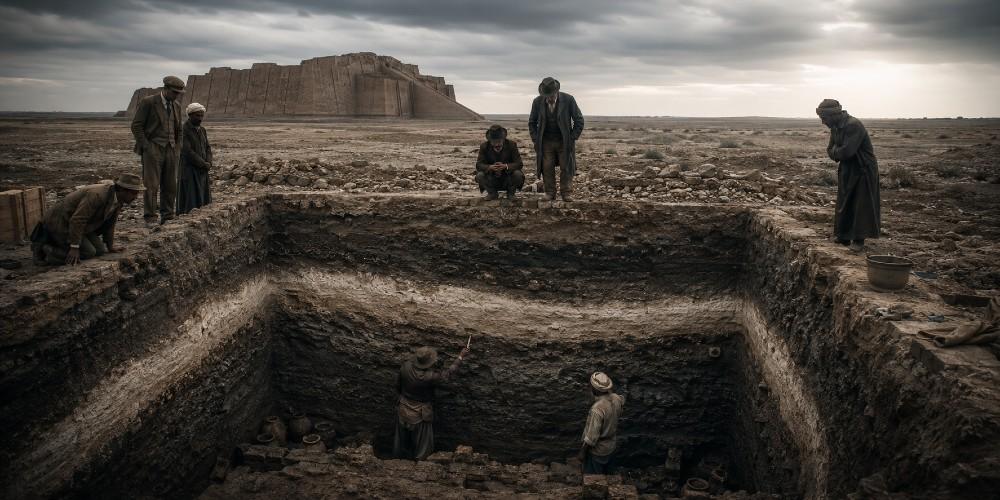
Picture the scene. Southern Iraq, the winter of 1929. Workmen have dug a shaft down through the ruins of Ur — the city the Bible names as the birthplace of Abraham — past the royal tombs, past the gold and the lapis and the bones.
Then the picks hit something strange. Eight feet of clean, water-laid silt. No pottery. No bones. No trace of human hands. Just sediment, laid down thick and sudden, separating one buried civilization from another. The director’s wife, Katharine, looked at it and said the thing everyone was thinking: “Well, of course, it’s the Flood.”
That moment, dramatized and re-told for nearly a century, sits at the heart of a story now circulating online — that Sir Leonard Woolley found physical proof of Noah’s deluge beneath Ur, and that the moment he did, the money mysteriously dried up. The implication is heavy: that the establishment couldn’t stomach what he’d found and quietly pulled the plug. It’s a gripping tale. But the genre we work in lives or dies on one thing — telling the documented from the merely dramatic. So let’s do exactly that.
What Woolley Actually Found
The flood layer is real. This is not in dispute. Excavating for the joint expedition of the British Museum and the University of Pennsylvania, Woolley sank a deep pit and uncovered a thick band of sterile silt — roughly 8 to 11 feet of it — sandwiched between two distinct layers of human occupation. Above it, the world of the Sumerian kings. Below it, an older settlement of the Ubaid period. Something had buried an entire culture under river-borne sediment and life had resumed on top of the grave.
Woolley announced it to a stunned world in 1929. His book Ur of the Chaldees became one of the most widely read archaeology books ever written. And here’s the part the sensational retellings flatten: Woolley never claimed a planet-covering flood. He argued for a catastrophic local inundation of the Tigris-Euphrates valley — devastating enough that, to the people living there, “that was the whole world.” Soon after, similar silt deposits surfaced at Kish to the north, and later at Shuruppak.
The flood-memory of Mesopotamia, preserved in the Epic of Gilgamesh and echoed in Genesis, suddenly seemed to have dirt under its fingernails.
The Money Didn’t Vanish — The Decade Did
Now the claim that demands scrutiny: that funding was “cut the same year” as a kind of quiet burial of an inconvenient truth.
The honest record tells a far less mysterious story. The dig at Ur did not end in 1929. It ran for five more seasons, finally closing in February 1934 after twelve years of work. What strangled the funding wasn’t a conspiracy — it was October 1929, the month Wall Street collapsed and the Great Depression swallowed the Western world. The Penn Museum was hammered. Excavation budgets everywhere evaporated. By May of 1933, the museum’s director wrote to Woolley suggesting he wind things down — not because of what he’d found, but because there was no money left to find anything with. The Carnegie Foundation even stepped in with funds specifically to publish the results.
And the man supposedly silenced for his discovery? Two years later, in 1935, the Crown knighted him for his work at Ur. That is not how empires bury heretics. The “suppression” angle simply does not hold water — and saying so plainly is not surrendering ground to the skeptics. It’s refusing to build the house of faith on sand.
The Mystery That Actually Survives
So is there nothing here? Far from it. The genuine puzzle is deeper and more durable than any funding rumor.
When later researchers compared the silt layers across Mesopotamia, the single-flood theory ran into trouble: the deposits at different cities dated to different centuries, and the layer at Ur didn’t even cover the whole town. So Woolley’s flood, as one event, didn’t survive the evidence. That much is documented fact, and we report it straight.
But step back. Why does nearly every ancient civilization on earth — Sumer, Babylon, the Hebrews, peoples across the globe who never met — carry the same buried memory of a world drowned in judgment and a remnant spared? That is the thread the legacy framing keeps tripping over. Scripture saw the scoffers coming:
“They deliberately forget that long ago by God’s word the heavens came into being and the earth was formed out of water and by water. By these waters also the world of that time was deluged and destroyed.”
Note the word: deliberately. The willful forgetting of the flood is itself a biblical prophecy — and we watch it play out every time the cross-cultural testimony of a drowned world gets reduced to coincidence. Here we move from reporting to discernment, and we’ll flag it as such: the dirt beneath Ur doesn’t prove Genesis by itself. But the worldwide stubbornness of the flood memory is not nothing. It looks like a scar humanity has never quite been able to forget.
Why It Matters Now
The Lord Himself made the flood a sign pointed at our own age. “As it was in the days of Noah, so it will be at the coming of the Son of Man.” People ate, drank, married, and ignored the warning until the waters came. The harbinger is not in the silt. The harbinger is in the forgetting — a civilization that buries the memory of judgment so it never has to reckon with the Judge.
So weigh these stories with open eyes. Stay informed beyond the breathless documentaries and the dismissive textbooks alike, because the truth usually sits between the two. Share what survives scrutiny, not what merely thrills. Sharpen the discernment to tell a real wonder from a manufactured cover-up — that skill is your armor in a world drowning in noise. And pray for wisdom, the kind that can hold both reverence and rigor at once, and that stands firm when the powers of this present darkness would rather you believe a tidy lie than wrestle with a holy mystery.
The flood layer beneath Ur is real. The cover-up is not. And the oldest warning in the world is still waiting for anyone willing to remember it.