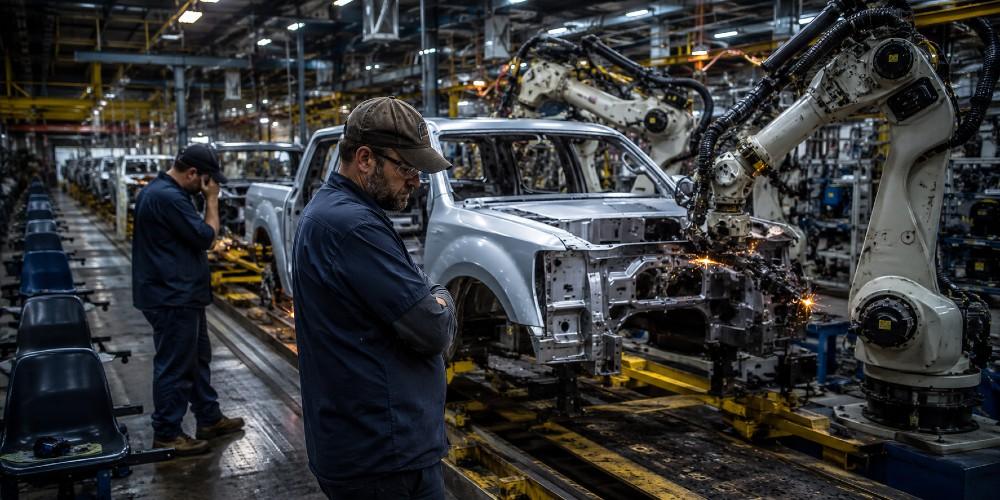
General Motors has delivered a stark lesson in modern American manufacturing: when government-pushed electric vehicle mandates meet market reality, it is the American worker who pays the price.
At the company’s flagship Factory Zero plant in Detroit-Hamtramck, more than 1,000 jobs have been eliminated, only to be partially filled by 50 collaborative robots, or “cobots,” now working alongside the remaining human employees attaching body panels on the assembly line.
This is not the story of innovation lifting all boats. It is the predictable outcome of an industry warped by political pressure to abandon proven internal combustion technology for expensive, low-demand EVs. GM softened its EV ambitions, paused production multiple times at the plant, and cut costs aggressively. The result? A workforce gutted while executives tout improved “safety and ergonomics.”
Union leaders are rightly furious. UAW Local 22 President James Cotton voiced the frustration of his members: “Our manpower is being taken away from us. From top to bottom, we’re disgusted that they have cobots in our plants.”
The union has filed grievances, highlighting legitimate concerns about job security and the risks of robots operating directly beside people. UAW President Shawn Fain framed it more broadly, arguing workers create unprecedented value yet fail to reap the harvest.
GM’s spokesman defended the move as essential for competitiveness, insisting the cobots enhance safety for remaining employees. Yet the timing could hardly be more tone-deaf. The company reported $4.25 billion in profits for the first quarter of 2026, a 22 percent increase year over year. Meanwhile, American autoworkers in the heart of Motor City face displacement.
The EV Mirage and Its Human Toll
The broader context reveals the folly of centralized industrial policy. Consumer demand for EVs has cooled significantly, driven by high costs, charging infrastructure gaps, and practical limitations that policymakers chose to ignore.
AAA surveys and repeated production pauses at Factory Zero underscore what many warned from the beginning: you cannot mandate a technology into viability when the market pushes back.
Automation in manufacturing is nothing new. Labor hours per vehicle have dropped dramatically since the 1980s. What stands out here is the acceleration amid policy-driven market distortion. Rising union wages secured in recent contracts clash with the economic pressures of unprofitable EV lines, leaving corporations with few options but to lean harder into robotics.
Critics on the left often decry corporate greed in such cases, yet remain strangely silent on the role of green mandates that forced automakers down this path. The same voices that celebrate “the future of work” rarely acknowledge the immediate pain inflicted on families who built this industry. Detroit’s proud legacy of American ingenuity is being hollowed out not solely by robots, but by decisions made far from the factory floor.
UAW grievances and worker outrage highlight a deeper tension: how do we ensure technological progress benefits the people who power our economy rather than rendering them obsolete? This is particularly acute in an America where manufacturing jobs have long anchored communities, provided dignity through honest labor, and supported multi-generational stability.
“The fruits of our labor have multiplied like never before, but workers aren’t reaping the harvest,”
said UAW President Shawn Fain. His words carry weight, even as solutions remain elusive in a contract negotiation cycle set for 2028.
Stewardship, Work, and the Human Element
These developments should prompt reflection beyond quarterly earnings reports. The Bible reminds us of the value of diligent hands and the importance of providing for one’s household. As 2 Thessalonians 3:10 declares, “For even when we were with you, this we commanded you, that if any would not work, neither should he eat.” Work is not merely economic; it carries moral and spiritual weight, forming character and sustaining families.
Corporate leaders and policymakers alike would do well to consider the long-term consequences of prioritizing efficiency over the people who execute it. True competitiveness comes not from discarding the workforce but from fostering environments where human ingenuity and technological tools complement one another.
America’s strength has always rested on opportunity for the working man, not on trading flesh-and-blood employees for machines in pursuit of fleeting political targets.
GM’s Detroit plant transformation serves as a cautionary tale. As automation spreads, our response must protect the dignity of labor while embracing genuine progress, unburdened by ideological fantasies that ignore human realities and market truths. The robots have arrived. The question remains whether our leaders will ensure American workers still have a place beside them.